.svg)


More Ads than Ever, the New Economics of Retail Media: Kiri Masters and Andreas Reiffen [LinkedIn Live Recap]

Most retailers still run Sponsored Products like it’s 2012: carve out a few “ad slots,” sell them to the highest bidder, and hope they don’t wreck the shopping experience.
But honestly, they often do.
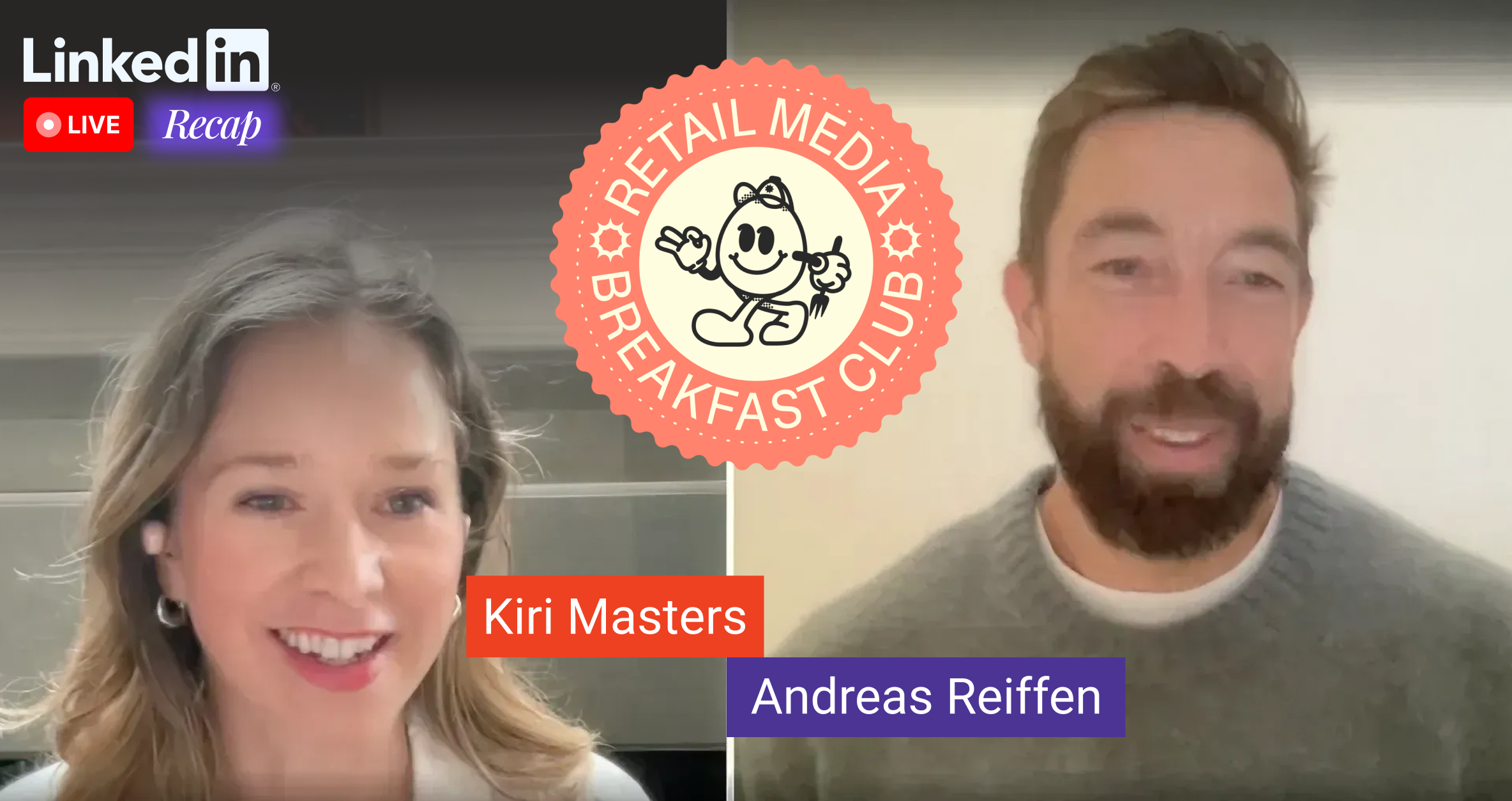
A few weeks ago, Retail Media Breakfast Club’s Kiri Masters and Andreas Reiffen, CEO, Pentaleap had a live session to review our latest H2 2025 Sponsored Products Benchmarks data.
They unpacked why the “fixed” model of sponsored products is quietly leaving money on the table and how a new approach, called fluid placements, changes the economics of retail media entirely. Currently being used by retailers across the globe, like Macy’s, The Home Depot and CVS.
Watch the whole conversation here.
The Old Way: “These Tiles are Reserved for Ads”
Kiri: “Retailers worry a lot about saturation. Is there a point at which showing more ads actually hurts performance?”
Andreas: “That way of thinking comes from a legacy setup. In the old world, you reserved specific tiles in the grid for ads and then tried to fill them with whatever demand you had.
That creates two problems:
1. You might force weak or irrelevant ads into premium positions.
2. You might trap highly profitable ads in low-visibility spots.
Either way, you lose.
Imagine a product grid with ten tiles. If only one advertiser has a truly relevant product and nine are mediocre, a fixed-slot model forces you to show all ten. Customers ignore them, don’t buy, and your best organic products get pushed down. That’s not monetization. That’s damage.”
The New Model: Rank Everything by Money per Impression
What replaces fixed slots is not “more ads.” It’s a different ranking logic.
Instead of asking “Is this tile organic or paid?”, industry-leading ad servers (like Pentaleap’s) ask: “How much money will this product make if I show it here?”
That includes:
- Retail margin (did it sell?)
- Ad revenue (did it get clicked?)
The two are combined into a single value: expected margin per impression. Products, whether paid or organic, are ranked by that number. If a Sponsored Product is highly relevant and has a strong bid, it rises. If it’s irrelevant or low-value, it sinks or disappears.
No reserved ad slots. No forced placements. These are the new economics of retail media.
Why this Beats Fixed Ad Placements
Kiri: “So why is this superior to just reserving certain placements for Sponsored Products?”
Andreas: “Because retailers shouldn’t be pitting selling ads and selling products against each other. Instead, they can approach it holistically and maximize revenue per page.
Here’s what fixed slots break:
- A weak ad in a premium slot can make less money than an organic product below it.
- A strong ad at the bottom of the page might deserve to be at the top.
Fixed placements ignore both. Fluid placements correct both. A highly relevant Sponsored Product with a high bid moves up because it earns more. A bad ad drops out because it doesn’t.”
.png)
Why “Too Many Ads?” Becomes the Wrong Question
Fluid placements change the entire debate. The old question was: “How many ads should we show?” The new question becomes: “Which products deserve to be seen?”
If an ad is relevant and profitable, it earns its way into view. If it’s not, it doesn’t.
Andreas’ emphasized this key mindset transition: To think about your products/sponsored products inventory in a unified way, instead of separating “paid vs organic” and pitting them against each other.
When a shopper is searching for a product, they are looking for “what’s useful.”
Fluid Ad Server, used by retailers across the globe like Macy’s, The Home Depot and CVS, aligns shopper relevance with retailer revenue. Fixed slots create an unfair power struggle between sponsored products and organic products, and it doesn't have to be that way.
.png)
The Big Takeaway for Retailers
This isn’t just an ad tech upgrade; it’s a business model shift. Retailers that still reserve ad tiles, treat Sponsored Products as a bolt-on and/or separate retail ranking from ad ranking are structurally capping their revenue.
The retailers moving ahead, like The Home Depot, Macy’s, Zalando, are letting Sponsored Products compete inside the same ranking system as organic products. That’s what turns retail media from a side hustle into a growth engine.
Audience Q&A from the Live Session
During the LinkedIn Live session, retail leaders and practitioners raised questions that went well beyond Sponsored Products benchmarks. Here’s how Andreas Reiffen responded:
How do CPCs actually work in Sponsored Products?
Asked by Andres Acosta Mejia
Rather than giving a price range, Andreas explained the mechanics: products are ranked by expected margin per impression, which blends retail margin and ad revenue. Higher bids lift products higher, but only if they are relevant enough to convert. Irrelevant products would need unrealistically high bids to win visibility, which makes the system self-correcting.
Do fluid placements only apply to grid-style product listing pages?
Asked by Andy H., US Foods
Andreas clarified that the model works across any layout. Grids, lists, carousels, and recommendation rows are all just different visibility curves. The algorithm understands how much traffic each position gets and moves products into the slots that generate the most value.
How will AI-style prompting change ecommerce search?
Raised by Bill Bledsoe and Ray Floyd
Shoppers no longer search like machines. They don’t think in keywords like “running shoes men size 10.” They think in needs: “good shoes for long walks” or “a gift for a 10-year-old who likes Lego.”
That creates a huge problem for old-school ecommerce search, which depends on matching exact keywords. Retailers and advertisers have to guess every possible phrase a shopper might type, which leads to gaps, wasted spend, and missed revenue.
What Andreas explained is that this is already being replaced by AI-driven matching between intent and products. Instead of advertisers bidding on thousands of keywords, they bid on the products they actually want to sell. The system then figures out which products fit a shopper’s query, no matter how it’s phrased.
For retailers, this has very practical effects. More searches become monetizable because you don’t need perfect keyword coverage.
- Shoppers see more relevant products instead of awkward keyword matches.
- Sponsored Products can be ranked naturally alongside organic ones, because they’re being matched to the same intent.
So AI-style search doesn’t just make the search bar smarter. It makes the whole retail media system easier to run, easier to scale, and more profitable.
What’s Next?
- Watch the LinkedIn Live session with Kiri and Andreas
- Learn more about Pentaleap’s Fluid Ad Server.
- Download our H2 Sponsored Products Benchmarks Report
Stay Ahead with Retail Radar
Subscribe for cutting-edge insight into the latest retail media developments and trends
.png)

.webp)