.svg)


Criteo vs. Pentaleap: Two Architectures to Monetizing AI Shopping Assistants
.png)
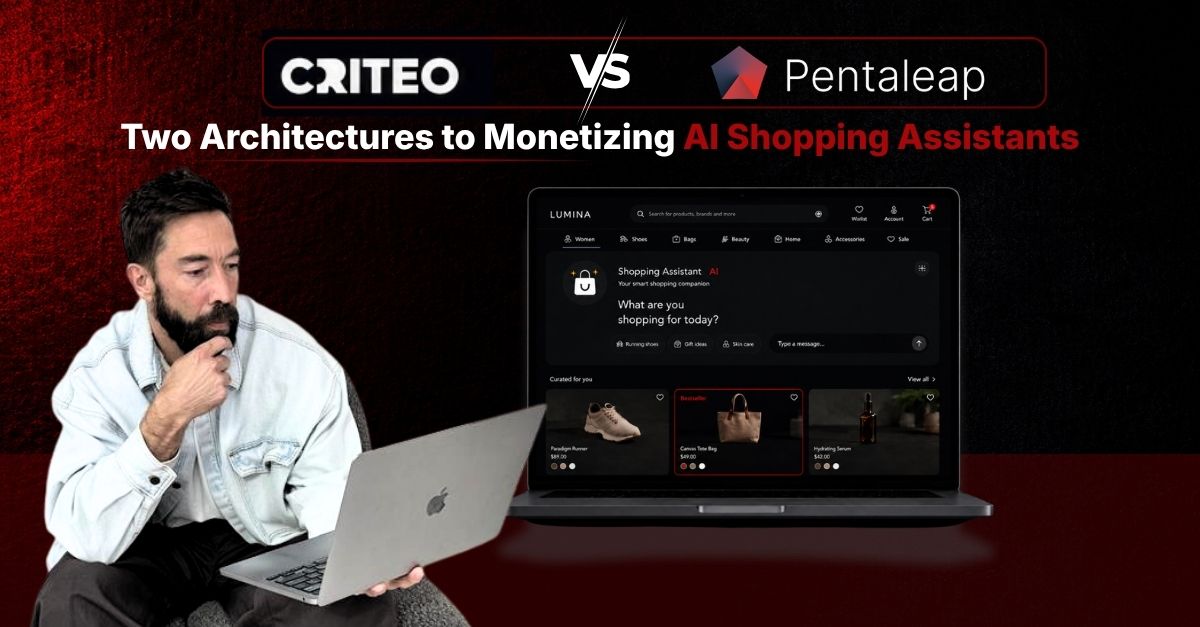
Your onsite AI shopping assistant is becoming a real surface, and the question on your desk is no longer whether to build one, but how to make it pay without breaking the retail media business you want to protect and grow. Strip away the vendor branding, and what you are really choosing is an architecture, one that shapes both your output quality and your vendor fees.
To be clear, I’m not talking about ads inside ChatGPT, or how your products get retrieved in someone else’s chatbot. I mean the assistant on your own site, the kind now gaining steam: Amazon’s Rufus, recently renamed Alexa for Shopping, and Walmart’s Sparky, with most large retailers now building their own.
There are two ways to make money. One is the easy part.
Two ways to monetize, and only one is the prize
The first is to sell prompts: suggested questions an advertiser buys, like keywords, so that tapping one makes the assistant surface that brand’s products. It is the easy, low-risk lever. It asks little of the technology, the commercial intent stays visible so trust holds, and every vendor will ship a competent version. Take that money, but it is not where the game is won.
Prompts are the easy money. Sponsored Products are the prize.
The second is to sell Sponsored Products, and there are two ways to do it. The bandaid places ads next to the output, clearly separated and labeled, hacked onto the same surface rather than embedded in the answer. It is easy, low-risk, and a perfectly reasonable place to start. But a more native embedding is the bigger opportunity, because the recommendation is where the shopper actually navigates and decides, so influence there is worth far more than an ad sitting at the edge of the screen.
The real prize, then, is to refine the output itself, so that sponsored and organic are decided together and a paid product rises only when it genuinely fits. Now the recommendation earns its keep, rather than an ad parked beside it. Higher potential, and much harder to get right.
Refine the recommendation. Don’t bolt onto it.
The LLM is the voice, not the brain
Think of the assistant as a voice and a brain. The language model is the voice. It talks to the shopper, reads intent, turns it into a query, and explains the result. What it does not do is decide which products win. By its makers’ own admission, it is not good enough at that yet, because it does not have the ecommerce transaction data it would need to make informed decisions. That decision, the ranking, sits in the brain beneath the voice, and that is where the two architectures split. Both aim at the same place: one re-ranked list that balances what the shopper wants with the margin you need across retail and media.
Both roads end at the same list.
Architecture A. Criteo builds the engine
Criteo, by their own engineering, runs the stack like this:
1. The LLM reads the shopper’s intent and turns it into a query.
2. Criteo’s own model retrieves candidate products, trained on organic clicks.
3. A second Criteo model re-ranks them for outcome.
4. The LLM presents the refined recommendations.
Steps two and three are the difference: both run on Criteo’s proprietary models. It is a serious, well-built approach, and an incumbent investing here helps validate the category. But the retrieval model is trained on organic clicks, the same kind of commerce signal a modern search and personalization engine already produces, so the design rebuilds, inside the ad layer, intelligence many retailers already run elsewhere. That is a legitimate choice, not a flaw. It raises a fair question: must you build this intelligence from scratch, or can you build on AI you already have?
The best AI may already be in your stack.
Architecture B. Pentaleap leverages the engine you already run
Pentaleap runs the same stack, with a different middle:
1. The LLM reads the shopper’s intent and turns it into a query.
2. Your existing search and personalization engine returns an outcome-based ranked list, on clicks, conversions, and revenue.
3. Pentaleap re-sorts the list intelligently, boosting products that carry advertiser bids.
4. The LLM presents the refined recommendations.
Step two is the difference: it reuses the engine you already run, already grounded in your commerce data, instead of a rebuilt model. Step three adds only what was missing, the ads. Macy’s runs Google Vertex AI for Retail Search with Pentaleap as the layer on top.
A fair objection is that boosting paid products erodes trust. It does not have to. Embedded sponsored products are labeled, just like any ad. The difference is that they live inside the recommendation, chosen with a full understanding of relevance, rather than on the edges of the screen with little. In a conversation, where the shopper has handed the assistant their judgment, that is what keeps the experience honest. The discipline is simple to state and hard to fake: a boosted product still has to earn its place, and the list reflects your real calculus, total margin across both revenue streams.
A tilted recommendation isn’t an ad. It’s a lie.
So what are you actually buying?
Here are the two architectures, side by side.
%20(1).png)
On a diagram they can look alike, but the AI underneath may differ enormously. So the real question is less who built the AI than which AI is running under the hood, and whether you want to hand your ad vendor or your search provider the authority over what your assistant recommends.
Two architectures, two business models
As this surface emerges and grows in importance, every RMN will need an answer, and the choice plays out on two levels. First the architecture: a proprietary engine built for you, or the engine you already run with an independent layer on top. That choice then shapes the business model: monetization bundled with a single ad vendor, or independent technology you operate with any ad server and any demand source. Together they decide the flexibility of your stack, the quality of the output, and your economics.
So if you are planning to launch an AI shopping assistant, think bigger than the assistant itself. Done well, you can monetize it as well as you monetize search and browse today, and quite possibly better. And with all the innovation now happening in ad tech, you have more than one good way to run it.
The opportunity is real. The choice is yours.
Let’s welcome retail media into the age of agentic commerce.
Stay Ahead with Retail Radar
Subscribe for cutting-edge insight into the latest retail media developments and trends
.png)

.webp)