.svg)


From Gold Rush to Growth Reset in Retail Media

.png)
Notes from Beet.TV's Cannes Lions 2025 coverage, with reporter Robert Andrews
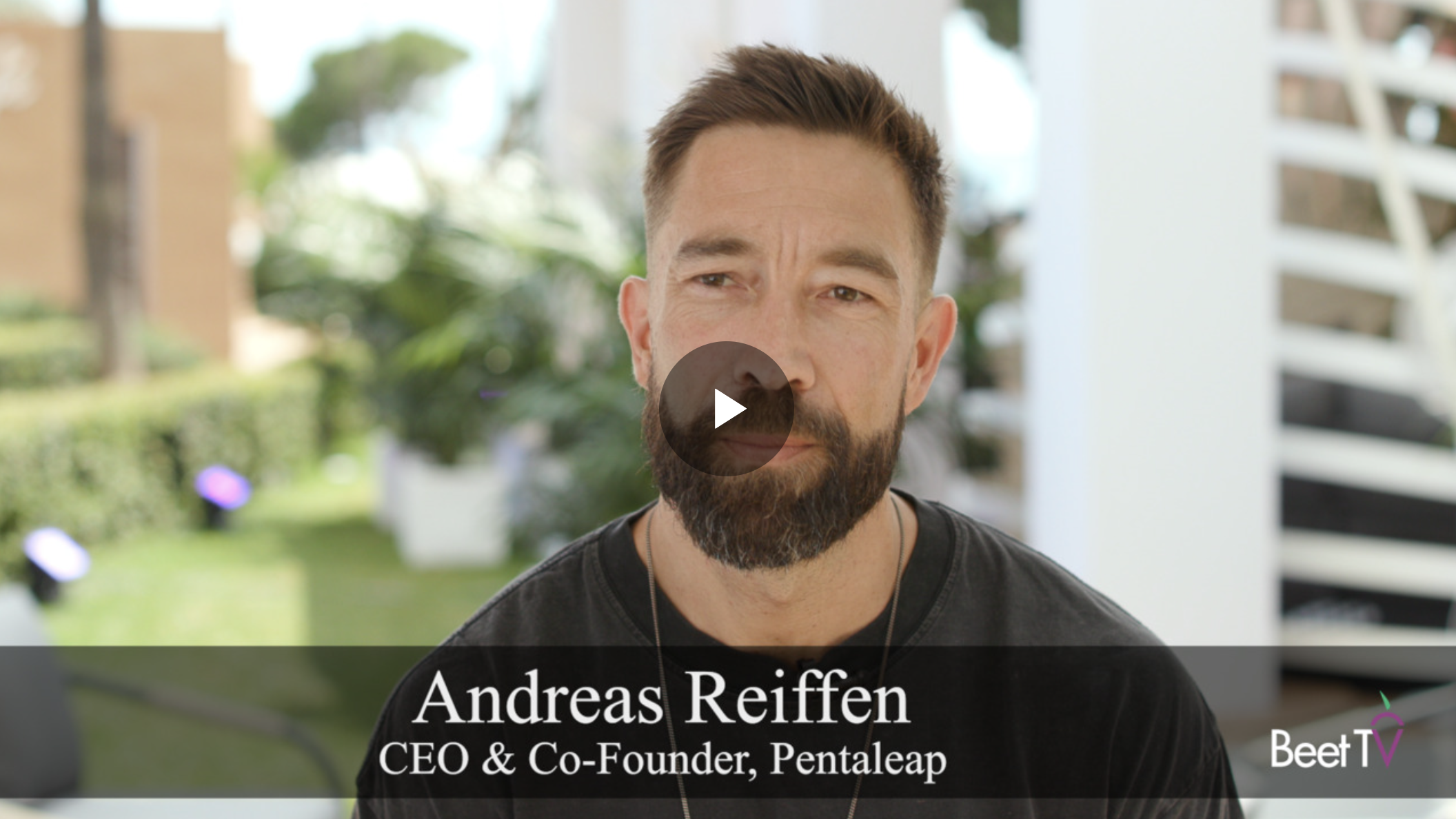
At Cannes Lions 2025, Beet.TV's Robert Andrews sat down with Andreas Reiffen, Founder and CEO of Pentaleap, to talk about where retail media actually stands after its rapid rise. The conversation covers why retailers rushed into the category in the first place, why that early excitement has curdled into frustration for many, and what Reiffen believes has to change structurally for the category to keep growing in a way that's sustainable rather than borrowed.
TL;DR: Retail media's current frustration isn't a sign the category is failing, it's a sign the early approach has run its course. Reiffen traces the category back to Amazon's early advertising push around 2014, through a rush of copycat "direct sales" models, to today's realization that most retailers are working hard to raise roughly the same trade dollars they always had. His prescription: bring back elements of the original ad network model to solve demand fragmentation, and let the retail media stack split into specialized, interchangeable components rather than one company trying to own the whole thing. Watch the full interview on Beet.TV.
Retail Media's Hype Cycle Started Long Before Anyone Called It That
Reiffen traces the category's real starting point back further than most conversations do, to around 2014, when Amazon first began seriously exploring advertising on its own product pages. At the time, most other retailers waved it off. Retail was about serving customers, not running an ad platform, and that sentiment held for years.
It changed once Amazon's advertising business had grown large enough that its absence elsewhere started to look like a real competitive gap. That realization, more than any single event, is what triggered the gold rush: a wave of retailers rushing to stand up their own retail media networks and capture what looked like easy new revenue.
What Reiffen sees now, roughly two years into that gold rush, is the excitement curdling into frustration. Retailers are putting in significant effort, but the dollars coming in often aren't meaningfully different from the trade budgets they were already collecting. The hard work of building a network isn't translating into the incremental growth many expected.
The Root Cause Is Fragmentation, on Both Sides
Asked what's driving that frustration, Reiffen points to fragmentation as the core structural issue, and he's careful to note it cuts both ways. Brands trying to spend across a growing number of retail media networks find it hard to manage that complexity. Retailers, in turn, find it harder to sell into brands that are already overwhelmed navigating a dozen or more separate relationships.
That fragmentation traces back to a specific industry decision. Retail media's earliest model, built by Hook Logic, was a network approach: money flowed in centrally and got distributed across many retailers. When Amazon's direct-sales, private-markets model took off, most retailers tried to copy it instead, reasoning that they didn't want brand budget flowing to competitors through a shared pool. The unintended consequence, in Reiffen's view, is that this direct-only approach hasn't scaled the way the network model could have. The fix, he argues, isn't abandoning direct sales, it's bringing back an ad network layer alongside it.
Two Separate Problems Need Two Separate Fixes
Reiffen breaks the path forward into two distinct pieces, and he's explicit that solving one without the other won't be enough.
The first is demand generation. This is where a more programmatic, ad-network-style approach comes in: building connections into the platforms where brands are already spending money, whether that's major search companies, The Trade Desk, StackAdapt, or Amazon's own advertising business, which Reiffen notes is itself evolving toward more of a network model.
The second is the direct sales side, which retailers will continue to run in parallel. Here, the fix isn't about demand access, it's about convenience. Historically, a brand had to negotiate separately for on-site budget, off-site budget, and in-store budget. What retail media networks need instead is a unified front end that lets a brand put money in once and have it work across every property, rather than fragmenting a single relationship into three or four separate conversations.
Underneath both of these, Reiffen adds a third requirement that's easy to overlook: the ad-serving technology has to actually be good. Getting demand in the door doesn't help if the ads shown on-site clutter the experience and fail to convert. Solving fragmentation and solving relevance are two different problems, and both need to be solved for retail media to translate ad budgets into real sales for brands.
Why the Old All-in-One Model Is Giving Way to Composable Systems
Reiffen describes a structural shift already underway: the retail media stack that used to live entirely inside one company, ad serving, front end, and demand connections all bundled together, is coming apart into specialized pieces. Some companies will focus on building connections to wherever brand demand already lives. Others will build the front end retailers and brands actually interact with. Others, like Pentaleap, will focus on the ad-serving layer itself.
The upside for retailers, in Reiffen's view, is straightforward: no single company running the entire stack means no single point of dependency. A retailer isn't locked into one ad-serving provider if a better one comes along, isn't limited to one sales force for demand, and isn't stuck with one front-end experience. Each piece can be evaluated and replaced on its own merits, which is a meaningfully different position than choosing one vendor to handle everything and hoping it stays competitive across every layer indefinitely.
FAQ
Is retail media growth actually slowing down? Reiffen doesn't describe it as slowing so much as maturing. The category is moving past its early hype phase, where the assumption was that standing up a network alone would generate easy new revenue, and into a phase where sustainable growth requires solving real structural problems, chiefly fragmentation on both the brand and retailer side.
Why did most retailers copy Amazon's direct-sales model instead of the earlier network model? Retailers wanted to protect their own brand relationships rather than share a common demand pool with competitors. Reiffen argues this reaction, while understandable, has limited how much genuinely incremental budget most retail media networks can access, since it left out the network-style demand generation that made the earlier model easier to scale.
What does a "composable" retail media stack actually mean in practice? It means no single company owns every layer, ad serving, front-end experience, and demand connections come from different specialized providers that plug into one another. Retailers can then replace or upgrade any one component without needing to rebuild the entire stack.
Does bringing back an ad network model mean giving up on direct sales? No. Reiffen sees the two working in parallel, not as a replacement for one another. Retailers keep their direct relationships with strategic brand partners while adding network-style connections to capture incremental demand from brands and budgets that direct sales alone can't reach.
This post is based on a video interview between Robert Andrews of Beet.TV and Andreas Reiffen, Founder and CEO of Pentaleap, recorded at Cannes Lions 2025. Watch the full interview on Beet.TV
Stay Ahead with Retail Radar
Subscribe for cutting-edge insight into the latest retail media developments and trends
.png)

.webp)