.svg)


Is Onsite Retail Media Infrastructure Holding You Back From Hitting Your Growth Targets? The Middlemen Podcast Recap

.png)
Most onsite retail media stacks were built like closed machines. One system bundles the ad server, front end, the campaign tools, and often controls demand as well.
For a while, this has been the only option available.
But it’s becoming increasingly evident to growth-minded leaders that this bundled structure is holding back their ability to reach onsite monetization growth targets.
When all your tech is locked into a single, monolithic stack, it feels prohibitively risky to contemplate a rip-and-replace; even when this set-up is underperforming and expensive.
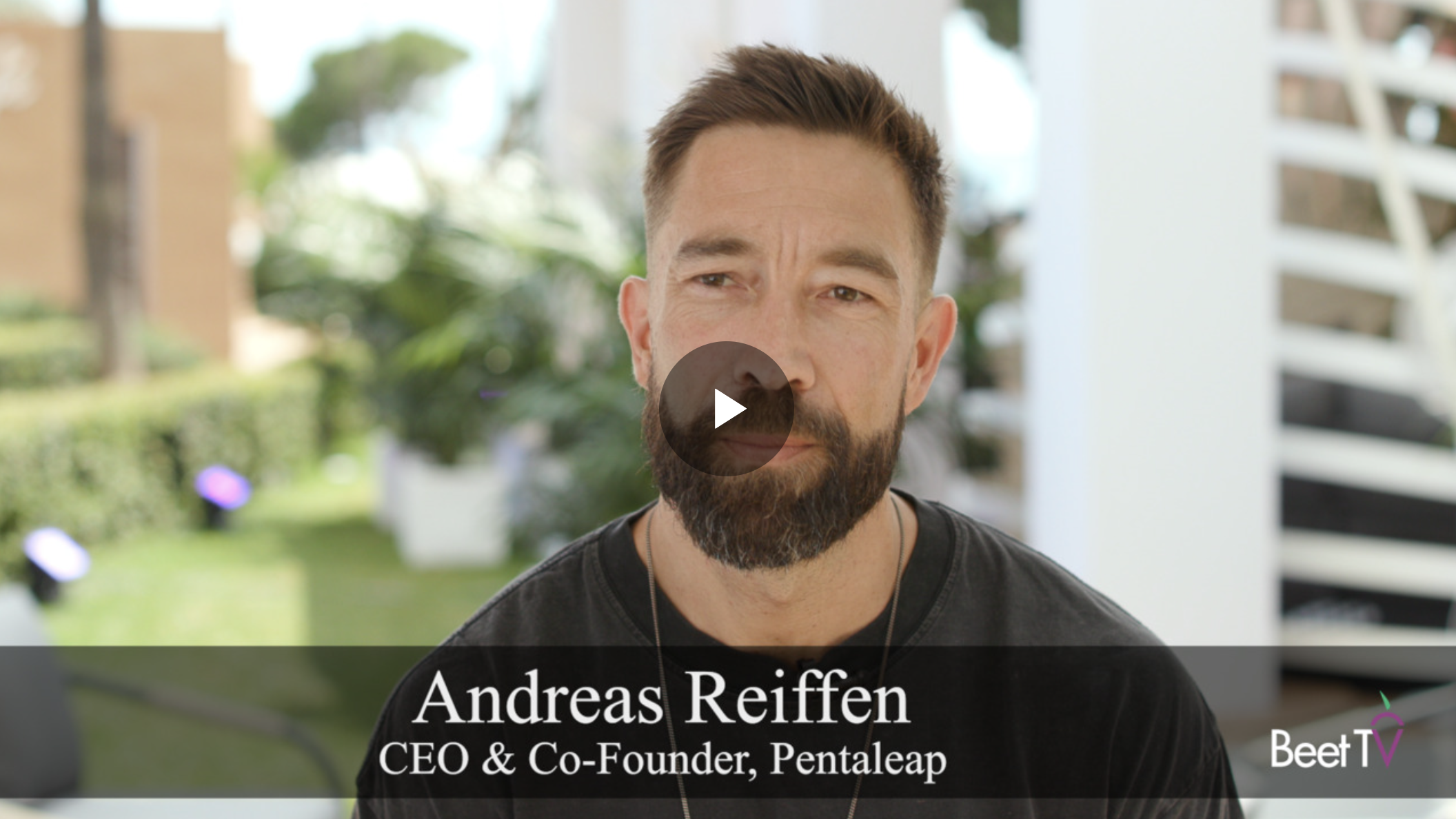
In a recent Middlemen Podcast conversation with Tom Limongello (host) and Scott Messer (co-Host), Pentaleap CEO Andreas Reiffen discussed why and how leading retail media networks (RMNs) are beginning to move away from monolithic setups and towards a structurally different approach: A decoupled best-in-breed tech stack.
This evolution starts with Pentaleap’s lightweight optimization layer that unifies organic and sponsored ranking and connects multiple demand sources to improve the performance of onsite monetization.
Pentaleap's Origin Story
Middlemen: “Tell us a little bit about Pentaleap and how you’ve built the business.”
Andreas: “We had a plan back in 2017, and that plan was exactly what we’re doing today. But at the time, we weren’t successful at all”.
Reiffen’s original idea was to build a mediation layer that serves ads alongside organic results while allowing retailers to plug in different front-ends and demand sources. Rather than forcing RMNs to rely on a single, expensive tech bundle, the goal was to give them:
- Control over onsite ranking
- The ability to create competition by connecting multiple demand providers
- Full stack flexibility with interoperable components from different vendors
Innovative retailers showed interest. Major technology players were paying attention.
“But ultimately the mass market simply was not ready, so, we sunset the product.” explained Andreas.
A few years later, onsite retail media matured, bloomed and then hit a growth ceiling. Retail media leaders are facing ambitious targets and beginning to realize that their ability to hit these numbers will require them to revisit the performance of sponsored products and evolve their stack.
Fast forward to today: Pentaleap’s optimization layer serves as an essential performance component that has majorly impacted onsite retail media success for a number of retailers—like Macy’s, CVS and The Home Depot.
Why Rip-and-Replace Creates More Risk Than Progress?
Middlemen: “During a recent client transition, Pentaleap worked alongside other vendors such as Criteo and Vantage to build a full stack. But when multiple providers are involved, doesn’t that make things more complicated?"
Andreas: “In many cases, retailers already rely on multiple providers. Onsite retail media operations involve thousands of advertisers, internal workflows, and commercial dependencies. The issue lies in replacing everything at once, which tends to introduce risk without addressing the underlying ranking logic. This is why Pentaleap offers a different approach.”
Pentaleap’s independent optimization layer allows retailers to improve ranking without disrupting the rest of the ecosystem. “Ad serving is separate from campaign management,” Andreas explained. He further added that in practice, that means introducing change at the decisioning layer first.
Once that foundation is stable, other components can evolve gradually. “So instead of ripping everything out,” Andreas said, “they can evolve their stack step by step.”
For example, a retailer can implement our ad-serving optimization layer with RTB technology while keeping existing campaign tools and front-end workflows in place. Demand sources continue to return relevant products and bids in real time, but the final ranking decision happens within the new layer.
This means a retailer can implement a new ad-serving optimization layer with RTB technology while keeping existing campaign tools and front-end workflows in place.
Demand sources continue to return relevant products and bids in real time, but the final ranking decision happens within the new layer.
Conversely, the old way of “switching from one monolith to another, you have to rip and replace ad serving, campaign management, and everything that’s brand-facing. That’s where the real nightmare starts”.
Why Is Relevance Harder in Retail Than in Publishing?
Middlemen: “From a publisher perspective, retail media seems more complex than traditional publishing. Why is relevance harder here?”
Andreas: “With a traditional publisher, there’s content on the site and ads around the edges. Retail is fundamentally different. The content is the product, and the ads are also products.”
On retail sites, sponsored products compete directly with organic products inside the same grid. Historically, organic ranking followed one algorithm while sponsored placements were inserted separately, often in fixed slots. But that separation has led to irrelevant ads that drag down performance and erode shopper experience.
Putting weak products in premium storefront space might generate short-term media revenue, but it hurts overall performance.
Andreas explained “If a product isn’t relevant, you don’t win the click. You don’t make ad money. Worse, you don’t sell the product.”
Pentaleap’s solution to this relevance problem is unified ranking.
With unified ranking, retail signals and advertising signals are evaluated together. Organic and sponsored products compete within the same product discovery system. Only the most relevant and commercially strong result rises.
“When you operate in silos,” Andreas said, “you can’t maximize the value of the page.”
What Does RTB Actually Mean in Onsite Retail Media?
Middlemen: “What’s Pentaleap’s stance on RTB, and how do you blend that into the front-end yield framework?"
Andreas: “When people hear RTB, they think of old programmatic display. Bad ads, traffic leaking off site. That’s not what this is.”
It’s fair that RTB still carries a lot of baggage in this industry. For many, it brings back memories of early programmatic display - low-quality ads, traffic leaking off-site, and limited control.
But in onsite retail media, RTB works very differently. It’s not about pushing generic ads into placements. It’s about connecting multiple demand sources to a retailer’s own environment, where the products being shown are still items the retailer sells.
“You can send requests to ten or fifteen partners. They return relevant products, and the system decides which ones appear.”
Retailers still maintain control over what shows up on their site. Incoming bids and product options are evaluated alongside relevance, and the final decision happens within the retailer’s own ranking logic.
When Merchandising and Media Stop Competing
Middlemen: “Retail organizations often experience tension between merchandising and onsite retail media teams. How can a unified ranking approach solve the conflict?”
Andreas: “As we all understand, merch teams are focused on selling products and maximizing retail margin and media teams want more ad inventory, Historically, there was no way to align these priorities.
Our unified ranking approach directly addresses this conflict. We layer our tech on top of existing ad servers and test compound margin, conversion rates, retail margin, and ad revenue.
What we consistently see is that conversion rates go up even when more ads are shown, because relevance has been improved. And ad revenue increases significantly as well. So, both sides benefit, and the internal fights largely disappear.”
What Will Happens When AI Changes Search?
The final part of the discussion focused on AI and conversational search.
Middlemen: “Looking ahead, two big questions: full-funnel measurement, and the rise of AI and conversational search. Does this model still work in that world?”
Andreas: “There are two possible directions. In one scenario, retailers lose the frontend to large AI platforms. In the other, they build their own AI-driven shopping experiences. But that won’t happen soon,” he said. “Users won’t change behavior overnight.”
What doesn’t change in either scenario is the need for strong decisioning logic.
As interfaces become more intent-driven, ranking only gets more complex. Systems still have to evaluate relevance and commercial signals in real time. An independent optimization layer allows that logic to evolve without forcing a rebuild of the entire stack.
The infrastructure choices retailers make now will shape how smoothly they adapt later.
The Big Takeaway for Retailers
At the end of the conversation, one thing stood out: RMNs who want to hit their growth targets are not limited to rip-and-replace with another all-in-one solution.
Now, they can choose to optimize ranking logic for organic and sponsored products, add multiple demand sources and swap out front-end, ad server and other components without blowing up their whole stack.
Pentaleap’s lightweight optimization layer makes this all possible, and is a logical first step for retailers who are moving towards future-proofing their onsite tech stack.
What’s Next?
- Listen to the full podcast Who Controls the Grid?
- See how unified ranking works
- Read about Pentaleap x Macy’s Partnership Pentaleap is Selected by Macy’s, Inc. to Power Its Next-Generation Retail Media Network
Stay Ahead with Retail Radar
Subscribe for cutting-edge insight into the latest retail media developments and trends
.png)

.webp)