.svg)


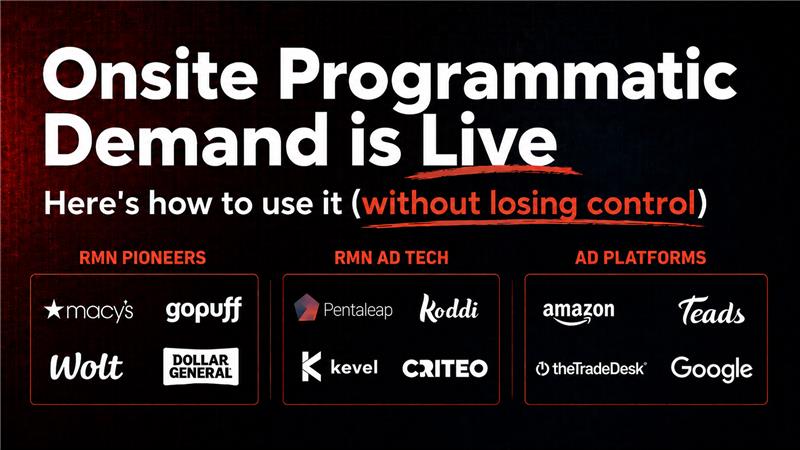
Onsite Programmatic Demand is live. Here’s how to use it (without losing control).
.png)
In December 2024, I argued that real-time bidding would let Google, Amazon, and Criteo reshape retail media. I was right about the direction and too optimistic about the timing.
Now, onsite ad inventory can finally be sold through programmatic pipes.
Three things are converging at once;
1. For the first time, retailers are the ones asking to plug into demand from large ad platforms, rather than guarding their inventory from them.
2. Ad tech players like Criteo, Koddi, Kevel or Pentaleap are building the pipes to connect demand.
3. A shared RTB standard is removing the integration tax that made all this impractical, because custom API integrations were always hard to build and harder to maintain.
Look at what shipped in the last year; Criteo became Google’s first onsite retail media supply partner inside Search Ads 360, opening search budgets that historically never touched retail media. Kevel connected Dollar General’s onsite inventory to programmatic buyers through The Trade Desk. Pentaleap and Teads delivered the first RTB integration for onsite sponsored products. And Macy’s connected Amazon Retail Ad Service through Pentaleap.
This is not the open web
That distinction matters, because RTB carries scars from display. We are not talking about anonymous impressions, link-outs to other sites, or budget leaking through a long chain of intermediaries. We are talking about endemic onsite inventory: sponsored products, display, and video on the retailer’s own grid. The shopper sees the same listings as before. The retailer still decides what is eligible, who can bid, and where it appears. RTB is simply the plumbing that lets trusted demand compete for a slot.
So why does this matter commercially? Because most retail media networks still cannot reach the budgets they were promised.
The demand gap has a number
Compare ad revenue to ecommerce revenue and the gap is stark. Amazon runs above 13%. Most other networks hit a hard ceiling somewhere between 1% and 3%.
Plenty of that gap is structural, and worth naming honestly. Amazon’s sheer scale makes it unavoidable for brands; its assortment and discoverability are hard to match, and its third-party marketplace hands it a seller base most retailers will never have. You will not rebuild that inside a walled garden, and nor should you try. But a real part of the gap is simpler than any of it. It is access.
Amazon meets brands inside the native Amazon Ads platform, where they can now steer campaigns on the Macy’s site, for example. Other brands work in Google, some through Search Ads 360 and some in the native Ads platform. Either way, they now have a way to reach a retailer’s onsite inventory inside the same environment they already use, with the same measurement, reporting, and targeting.
Meet brands where they already are
The large platforms bring three things a direct sales team cannot manufacture: standardized measurement, existing advertiser relationships, and trust earned over years of spend. Most important, they reach the people who actually control media budgets, the agencies and search marketing specialists inside major brands. Connecting to them does not replace your sales motion, it extends it to budgets your team will never have the headcount to win on its own. Onsite retail media becomes part of the broader marketing mix, bought with a true performance media mindset.
Direct sales and programmatic are not rivals.
The operating model that follows is a blend, not a choice. Your top brands stay with direct sales, where relationships and custom programs pay off. Your torso and tail connect programmatically, where automation works in a way that manual selling never could. Both feed the same grid, and unified ranking decides what wins.
None of this is frictionless, and the questions are fair: who chases which brands, how you control whitelisting per platform, how you align and pay your own sellers, and whether the platforms’ take rate still leaves you ahead. Google, Amazon, and The Trade Desk are weighing their own version, looking to decide whether the juice is worth the squeeze.
How to start without losing control
While it is fair to raise those points, there are safe ways to begin, in a very controlled way. A simple sequence works:
1. Keep your strategic brands in direct sales, where the relationship and custom programs justify the hands-on effort.
2. For every other brand, calculate one ratio: ad revenue against ecommerce revenue.
3. Flag the brands with a low ratio. They are only giving you trade dollars while their media dollars sit elsewhere, which makes them your first candidates to whitelist for demand partners.
4. Route each one to the demand partner that already holds the strongest relationship with that advertiser.
5. Align with your sales team on who owns what, so nobody is surprised when a programmatic bid competes for a brand they thought was theirs.
You will not be building this alone.
We, Pentaleap, indirectly compete with Koddi, Criteo, or Kevel. At the same time, it is the joint effort that is now addressing the fragmentation issue brands and retailers suffer from. Every credible RTB connection makes brands more comfortable buying this way, and that lifts everyone: retailers find new revenue, brands get reach and control from their preferred ad platform’s campaign UI, and the ad tech companies grow into a far larger market.
Where you go from here
If you want to access this demand, you have two paths.
1. Work through an existing retail media vendor that offers onsite ad serving and connects demand.
2. Add an independent layer like Pentaleap to your stack that connects multiple ad servers, orchestration tools, and multiple major ad platforms.
Retailers finally have real choices. If you are not Amazon, Walmart, or a category leader like The Home Depot, you need a new growth driver beyond direct sales, and this could solve your problem. As an RMN leader, you are chasing an ambitious number, and you probably already have a thesis for where that growth should come from. Connecting demand belongs on that list for 2026.
Retail media is more exciting than ever.
The networks that move now will get very special attention and support. Ad tech players, Google, Amazon, and The Trade Desk, everyone wants to make it work.
I will end with questions, not answers. What is the real objection here: too many partners chasing the same brands, losing control, or breaking a sales team built to sell direct? And the one I keep turning over, could a smaller retailer keep trade dollars out of onsite entirely and treat it as clean media from day one? Tell me in the comments.
Stay Ahead with Retail Radar
Subscribe for cutting-edge insight into the latest retail media developments and trends
.png)

.webp)