.svg)


The Three Architectures: How Retail Media Tech Actually Works


For most enterprise retailers, the first phase of building a retail media network followed the same pattern. Plug in an ad server, start running sponsored products, and capture the easy revenue. It worked. For a while.
As these networks mature, a structural problem has emerged. You find yourself caught between two outcomes you should not have to choose between: a high-quality shopper experience, or growing ad revenue. The root of that tension is not your sales team or your advertisers. It is the architecture. When the logic that decides which products your customers see is fragmented across separate systems, the result is a product grid that works against itself, and against your business.
The good news is that this is a solvable problem. But the solution depends on understanding where your ranking logic actually lives.
TL;DR: The success of a retail media network depends on where its onsite ranking logic lives. While legacy ad servers create silos and search-integrated models create technical debt, an independent retail media optimization layer allows you to unify organic and sponsored results, ingest demand from multiple sources via RTB, and maintain total control over your technology stack without vendor lock-in.
Architecture One: Logic Inside the Ad Server
The most common architecture in the industry today is one where the commercial logic lives entirely inside the ad server. Your search engine handles organic results. A separate third-party ad server handles sponsored slots. The two systems operate in isolation from one another, each with its own relevance scores, its own keyword matching logic, and its own prioritization rules.
Because the ad server does not see what your search engine is doing, it frequently surfaces products that are redundant or irrelevant to what your shopper is actually looking for. That is not a vendor failure. It is a structural one.
This creates two compounding problems.
The first is relevance. Sponsored products fill positions on your page based on bid price and budget, not on whether they belong there. The shopping experience degrades. Conversion rates follow.
The second is a demand ceiling. Legacy ad servers are closed ecosystems that were not built for real-time bidding. Access to incremental budgets from large external platforms requires infrastructure that a bundled stack was never designed to support. Revenue plateaus. The trade budget trap closes in.
These are architecture problems, and changing vendors within the same model does not solve them.
Architecture Two: Logic Inside the Search Engine
Some retailers have responded to the relevance problem by moving commercial logic into the search engine itself. Sponsored products are treated as attributes within the organic ranking algorithm, so that one system makes decisions for the entire grid. Relevance improves. That part works.
The trade-off is agility. By entangling commercial logic, bids, budgets, advertiser pacing, with your core ecommerce infrastructure, you create a system that is genuinely difficult to change. Your search team optimizes for conversion rate. Your retail media team optimizes for ad yield. Every change to the ad program requires a change to the search configuration, leading to longer development cycles and code freezes that tend to arrive at the worst possible time.
Real-time bidding becomes nearly impossible. RTB requires low-latency decisioning that most search platforms were not built to carry, which means the demand ceiling from Architecture One remains largely intact.
You have solved relevance. But you have traded one form of dependency for another.
Architecture Three: The Independent Retail Media Optimization Layer
An independent retail media optimization layer sits between all your demand sources and your frontend product grid. It connects to your search engine and to one or more ad servers or RTB pipes, ingests results from all of them, and applies a unified ranking algorithm to determine the optimal placement for every product on the page, whether organic or paid.
This is what unified ranking actually means in practice. Not a feature. A structural decision about where the intelligence lives, and crucially, who controls it.
Because the optimization layer is decoupled from the systems it connects, you keep every tool already in use. Your campaign UI stays. Your search engine stays. Your frontend stays. The optimization layer improves the output of the whole system without replacing any part of it. And because it connects via RTB, it opens demand from major external platforms without requiring you to switch vendors or disrupt existing workflows.
The retailer controls the ranking logic. The vendor supplies the infrastructure. Those are different things, and the distinction shapes everything downstream.
This is the third architecture. It resolves the relevance problem from Architecture One and the agility problem from Architecture Two, without introducing a new dependency in their place.
Real-World Evidence
This shift is not theoretical. It is already being executed by some of the largest retail media networks in the US, and the pattern across all of them is consistent: step-by-step modernization, no rip-and-replace, no disruption to existing workflows.
A leading US fashion retailer ran a legacy ad server for campaign management alongside a separate AI-powered search platform for organic. Sponsored and organic ranking operated independently, and demand access was limited to existing partners. By adding Pentaleap as an optimization layer on top of the existing stack, they unified the ranking and connected a major retail ad network via RTB without replacing their frontend or their core ad server. 175 new advertisers joined since the pilot launched ahead of the 2025 holiday season.
A leading US home improvement retailer ran a legacy ad server with sponsored products siloed from organic search. They decoupled the stack, using a frontend orchestration tool for campaign management and Pentaleap for unified ranking and ad serving underneath. Two best-in-class systems, each doing what it was built for, coordinated by an independent layer in the middle.
A leading US health and beauty retailer kept their existing campaign UI, which their sales team and advertisers were already using, and added Pentaleap as the ranking layer to improve relevance and performance. Connecting incremental demand from a major external platform is the next step, something that would not have been technically possible under the legacy architecture.
Each of these was a step-by-step modernization. The stack did not change overnight. Performance improved at each stage.
For a broader view of how retailers are navigating these decisions across onsite, offsite, and in-store, see Building an RMN across onsite, offsite and in-store? 3 options: two with real tradeoffs, one middle path.
The Performance Gap: Why Decoupling Drives Revenue
The financial case for an independent optimization layer is grounded in A/B testing across retailers and verticals. When you move from a siloed ad server to a unified ranking layer, ad revenue lifts of between 80% and 140% are consistently observed. That range is not a projection. It is the result of live tests run against existing stacks.
These gains come from three areas. Unified ranking reduces cannibalization, so you stop paying to show ads for products your shoppers would have clicked on organically anyway. RTB demand increases auction density, which drives up the average price-per-click across your inventory. And because sponsored placements are now held to the same relevance standard as organic ones, you can expand ad load without degrading the shopping experience or suppressing conversion.
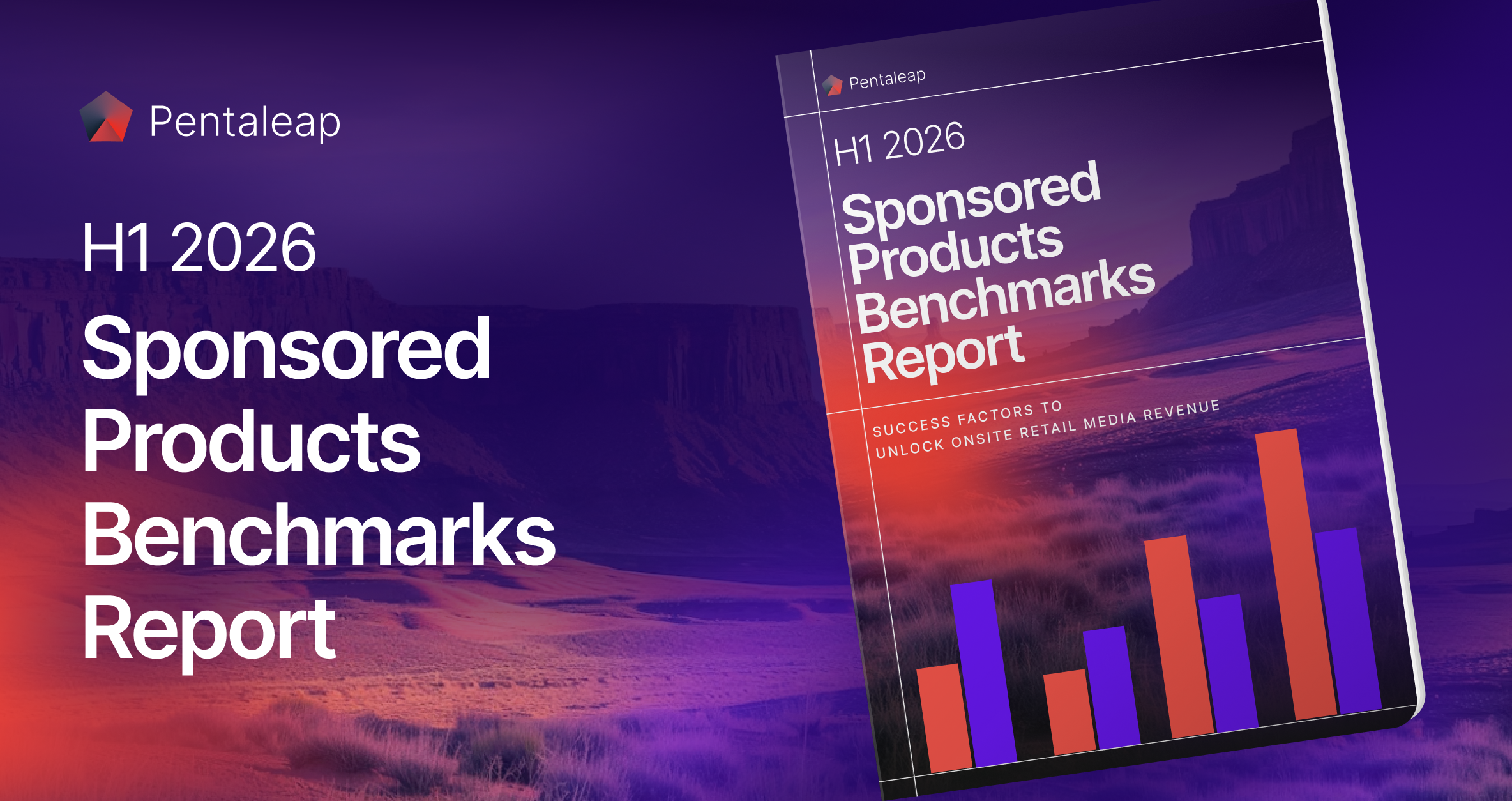
The Pentaleap H1 2026 Sponsored Products Benchmarks Report alludes to this trend across the industry. Sponsored products coverage grew +10% YoY across tracked retailers in Q4 2025 to Q1 2026, accelerating from +7% in the prior period. The retailers driving that growth are not doing it by stacking more fixed slots. They are distributing placement across the grid where relevance supports it, which is only possible when the ranking logic is independent.
The Hidden Cost of Vendor Lock-In
If you are operating under a bundled stack today, you already know what the ceiling feels like. You cannot easily innovate your frontend without triggering a migration. You cannot access open demand without going through your vendor's pipes. You cannot change components without a multi-year engineering commitment. The full-stack promise, which felt like simplicity at the start, becomes a constraint as your program grows.
The reason is structural. Legacy ad tech vendors built bundled stacks to create pricing power, and that model depends on you staying on their frontend, their campaign UI, and their demand infrastructure simultaneously. Some have begun adopting the language of unified ranking and decoupled architecture, and that shift is a meaningful signal about where the market is heading.
But adopting the language is not the same as adopting the model. True decoupling, the kind that lets you swap in better tools as they become available, would require dismantling the very mechanism that protects their margins. The architecture they would need to offer is the one their business model prevents them from delivering.
An independent optimization layer changes that relationship. You own the ranking logic. The vendor has no lock-in to protect. The business model works only if your performance is there, which means your incentives and your vendor's incentives are finally pointing in the same direction.
As the retail media landscape becomes more competitive, the retailers who treat their technology stack as a strategic asset rather than a utility will be better positioned to adapt. The most valuable part of a retail media network is not the ads. It is the logic that decides where they go.
Key Takeaways for Senior Operators
Success in the next era of retail media requires a shift from buying a solution to building an architecture. Prioritize systems that offer unified ranking across organic and sponsored results to protect your shopper experience. Ensure the ability to ingest RTB demand from external sources to remove the demand ceiling. And decouple the ranking logic from the campaign UI, so no single vendor owns your roadmap.
The 80-140% revenue lifts seen across leading US retail media networks are not the result of better sales pitches. They are the result of a superior technical foundation.
Frequently Asked Questions
What is a retail media optimization layer?
A retail media optimization layer is an independent software tier that sits between a retailer's demand sources (ad servers, RTB pipes) and their product grid. It uses unified ranking logic to determine the best placement for every product on a page, ensuring relevance and ad yield without replacing the existing tech stack.
How does unified ranking differ from traditional ad serving?
Traditional ad serving treats sponsored products as a separate decision applied to the page after organic results are generated. Unified ranking evaluates organic and sponsored products simultaneously using the same relevance and performance signals. This prevents redundancy, improves the shopper experience, and allows for higher ad load without conversion rate decline.
Can retailers keep their existing ad server when adding an optimization layer?
Yes. An independent optimization layer connects to your existing ad server and uses it as a demand source, while taking over the ranking logic to improve performance. Existing campaign workflows remain intact. Additional demand sources can be added incrementally, at whatever pace makes sense for your program.
Why is RTB demand important for retail media networks?
Real-time bidding allows you to access demand from a far wider pool of advertisers than a direct sales team can reach alone. By connecting to external platforms via RTB, you increase auction density, improve fill rates, and access true media budgets beyond the trade budget ceiling.
Ready to take control of your retail media architecture?
Discover how Pentaleap's independent optimization layer can drive an 80-140% lift in your ad revenue while protecting your customer experience. Schedule a strategy session with our team today.
Stay Ahead with Retail Radar
Subscribe for cutting-edge insight into the latest retail media developments and trends
.png)

.webp)