.svg)


Why Retail Media’s Search Problem Starts With Two Algorithms Doing Different Jobs

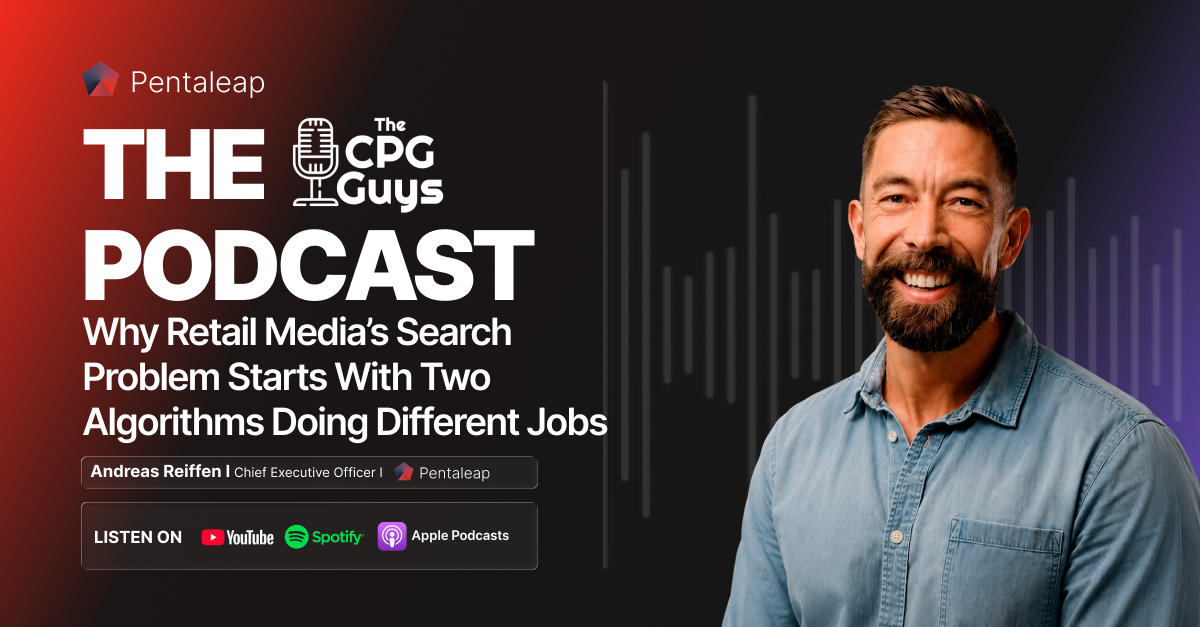
Andreas Reiffen, Founder and CEO of Pentaleap, joined The CPG Guys podcast alongside Michael Krans, Vice President of Retail Media at Macy’s Inc., to talk about what’s structurally broken in retail search, and what fixing it actually requires. Krans oversees the Macy’s Media Network across Macy’s, Bloomingdale’s, and Bluemercury. Together, they worked through the relevance problem at the core of most retail media performance issues, why real-time bidding is the right technical unlock, and what it means in practice for a retailer like Macy’s to open up its network without losing control.
TL;DR: Retail media’s search problem isn’t a targeting problem or a measurement problem. It’s an architecture problem. Organic and sponsored ranking have historically run on separate algorithms optimizing for different things, and that split quietly degrades both the shopper experience and advertiser ROI. Reiffen and Krans explain how unifying those systems, and bringing in outside demand via real-time bidding, is producing measurable gains in click-through rate, conversion, and advertiser confidence at Macy’s. The model that emerges isn’t a fully open exchange. It’s what Krans calls a “hedged garden”: more accessible than a walled garden, but still controlled. Watch the full episode on YouTube.
Key Takeaways
- Organic and sponsored search have run on separate algorithms, each optimizing for a different goal: the customer’s intent versus the advertiser’s bid. That disconnect produces a disjointed shelf and erodes trust on both sides.
- Relevance protects monetization, not the other way around. Macy’s enforces a rule that a sponsored product must be at least as relevant as the organic product it would displace. A high bid does not override relevance.
- Unifying ranking logic measurably improves performance. Pentaleap reports more than double the click-through rate and more than double the conversion rate on sponsored placements once paid and organic ranking are unified under a single system.
- Trade budget doesn’t scale the way retail media ambitions require. Trade spend moves proportionally with e-commerce revenue, which means retailers chasing 10–30% annual growth in retail media ad revenue can’t get there on trade dollars alone.
- Real-time bidding is the technical unlock. RTB replaces expensive, bespoke API integrations with a model that lets retailers connect outside demand sources, including Amazon Retail Ad Service and Google, without rebuilding their ad stack.
- The direction of travel is toward “hedged gardens.” Retailers retain control of pricing, brand safety, and the customer experience, but make their inventory more accessible to programmatic buyers, reducing the fragmentation fatigue brands currently navigate across 200-plus retail media networks.
- The shift will be gradual. Reiffen expects something closer to a 50/50 split between direct and network-sourced demand as the model matures, not a wholesale move away from direct sales.
The Core Problem: Two Algorithms, One Shelf
Krans framed the historical problem clearly: organic and sponsored search have operated as “church and state”, two completely separate systems solving for different things. Organic tries to surface what’s most relevant to the shopper. Sponsored answers who is willing to pay the most. When those systems don’t talk to each other, the result is a shelf that can literally lock a sponsored product into a fixed position regardless of whether the shopper would ever buy it.
In fashion and lifestyle categories, where fit, style, and visual relevance are the primary purchase drivers, that friction is especially costly. Showing the wrong shoe because the bid was high doesn’t just cost a click. It costs trust.
Reiffen described the same dynamic from the technology side. In the legacy model, sponsored ranking was built to surface what advertisers wanted shown, while organic ranking was optimizing for something closer to margin per impression.
Retailers ended up promoting products shoppers didn’t want, generating ad revenue in the short term while quietly dragging down conversion, and in some cases leaving the retailer worse off overall than if the slot had shown the most relevant organic result.
Relevance as the Floor, Not the Filter
Macy’s approach to this is explicit: there is no pay-to-play model where a low-relevance item can buy its way to the top. A sponsored product has to be at least as relevant as the organic product it would displace. The reasoning follows directly: chase short-term ad revenue at the expense of relevance, and the audience advertisers are paying to reach starts to degrade.
That discipline shows up in how Macy’s monitors performance. The team tracks “pogo-sticking”, where a shopper clicks into a product page and immediately bounces because the result didn’t match their intent, as a direct signal that the search experience failed.
Since working with Pentaleap, Krans says that behavior has been moving in the right direction, with add-to-basket rates and downstream conversion improving on top search and browse placements.
Reiffen pointed to click-through rate as the clearest proxy for relevance. Comparing legacy sponsored placements to unified-ranking placements, Pentaleap has observed CTR more than double, paired with a similar lift in conversion rate. That combination means more advertiser revenue and better retail margin at the same time, rather than one coming at the expense of the other.
Why Trade Budget Hits a Ceiling
A theme that ran through the conversation: most retail media revenue today is still repurposed trade budget, not incremental media spend. Trade budget scales proportionally with e-commerce revenue, which creates a structural ceiling. A retailer can’t grow retail media at 10-30% annually by relying on the same dollars that were already earmarked for them.
The earliest retail media model was actually a network approach. Hook Logic predated most of what the category now recognizes as retail media, before the industry largely pivoted to copying Amazon’s direct-sales model. The problem, as Reiffen noted, is that almost no one has Amazon’s scale, so the direct-only model runs into a ceiling quickly. The fix isn’t abandoning direct sales. It’s giving brands a way to deploy budget they’re already spending elsewhere, on Google, The Trade Desk, Amazon, into retail media inventory without requiring a separate negotiation with every network.
The conversation also touched on a U.S.-specific constraint: Robinson-Patman, a decades-old federal trade law, limits how trade funds can be allocated across retail customers in ways that don’t apply outside the U.S. That adds another structural layer on top of the scaling problem that brands and retailers operating domestically have to work around.
RTB Is the Technical Unlock, Not the Goal
The most concrete technical thread in the conversation was real-time bidding, specifically how RTB logic developed in programmatic display advertising translates into a model that works for endemic sponsored products in retail search.
Historically, connecting outside demand to a retail media network meant building and maintaining expensive, bespoke API integrations. That capability was mostly available to large networks with the engineering resources to support it. RTB changes the economics. Instead of a campaign physically living inside one ad server, an ad request goes out in real time and draws responses from multiple demand sources simultaneously, then serves the most relevant, highest-value result.
Reiffen’s framing: once RTB infrastructure is in place, it’s inexpensive to maintain and far easier to extend to new demand partners than a one-off API integration. The cost per additional connection drops significantly.
For Macy’s, this means the Macy’s Media Network can now run its legacy partner Criteo and Amazon Retail Ad Service in real-time competition for the same placement. Krans described the effect as turning the ad server into “a true marketplace rather than just a delivery truck,” where multiple demand sources compete and the most relevant, highest-value product wins.
Crucially, this isn’t unvetted external advertisers entering the front end. The inventory remains fully endemic. RTB determines which demand source, whether Macy’s own sales team, Amazon’s, or eventually others, is funding the placement. The shopper-facing experience stays consistent.
From Walled Gardens to Hedged Gardens
Krans pushed back on the assumption that opening up inventory means giving up control. In practice, the change is in the transaction layer: brands bid programmatically while the retailer retains control over floor pricing, brand safety, and the customer experience. His framing: “We aren’t really giving away the keys to the castle… we’re installing automatic doors so partners can enter more easily.”
The term that stuck was Bahn’s: not a walled garden, but a “hedged garden.” The retailer still owns the data and the customer relationship. The wall has gaps that let demand flow more easily, in both directions, without ceding the perimeter.
This is worth noting as a direction of travel for the category. With more than 200 retail media networks now in market, the fragmentation problem for brands is real. A model that makes demand deployment less friction-heavy, and doesn’t require brands to rebuild their infrastructure for each new network, addresses a problem the current structure has made worse.
A Note for Brands and Retailers
Reiffen’s advice on the technology side: a composable, best-in-breed approach, choosing ad serving, frontend orchestration, and demand sources independently, gives retailers the ability to swap any one component without rebuilding the whole stack. That flexibility becomes more valuable as the market consolidates around a smaller number of infrastructure providers.
Krans’s advice was aimed at brands: stop treating retail media purely as a bottom-of-funnel conversion channel. A retailer like Macy’s carries millions of high-intent shoppers, and the audience data that comes with that is an asset for brand building, not just SKU-level conversion.
The caution he added for retailers: don’t let data science crowd out merchandising judgment. The goal is still to inspire a purchase that makes the shopper feel good. The technology supports that outcome. It doesn’t replace it.
FAQ
Why does separating organic and sponsored search hurt performance? Each system optimizes for a different goal: relevance to the shopper versus willingness to pay. Their outputs frequently conflict. The result is sponsored placements that don’t match shopper intent, which depresses CTR, conversion, and ultimately the value of the placement itself.
How does Macy’s prevent low-relevance products from buying top sponsored positions? A sponsored product must meet the same relevance threshold as the organic product it would displace. Bid value alone doesn’t determine placement. That constraint protects both shopper experience and the long-term value of the inventory.
What does real-time bidding actually change for retail media? It replaces expensive, bespoke API integrations with a shared, maintainable infrastructure that lets multiple demand sources compete for the same placement in real time. That makes it practical for mid-size networks, not just the largest players, to connect external demand.
What’s the difference between a “walled garden” and a “hedged garden”? In a walled garden, the retailer controls access completely. In a hedged garden, the retailer still controls pricing, brand safety, and the shopper experience, but the transaction layer is open enough for brands to access inventory programmatically, without a bespoke integration per network.
This post is based on a conversation between Sri Rajagopalan and Peter V.S. Bahn of The CPG Guys, Michael Krans of Macy’s Inc., and Andreas Reiffen of Pentaleap. Watch the full episode on YouTube.
Stay Ahead with Retail Radar
Subscribe for cutting-edge insight into the latest retail media developments and trends
.png)

.webp)