.svg)


Why Your Fixed Slots Are Quietly Costing You


What fixed ad slots are quietly trading away, for teams evaluating onsite retail media solutions
TL;DR
- If growing sponsored revenue means opening yet another fixed slot and picking a fight with your ecommerce team over ad load, that's not a growth problem. It's an architecture ceiling.
- The Cause: Most retail search pages are run by two systems that don't talk to each other, one ranking organic products, one deciding sponsored placement, each blind to what the other decided.
- The Fix: Unified ranking puts both decisions inside one coordinated system, without ripping out the ad server or search engine you already run.
- The Proof: As we reported in our H1 2026 Sponsored Products Benchmarks Report, Amazon and Walmart both sustain high sponsored coverage across more of the page than a purely fixed model allows. That result is only possible when sponsored and organic decisions aren't made blind to each other.
- Three questions later in this piece help you tell whether you're actually at that ceiling.
Picture the Tuesday before your quarterly business review. The coverage report looks fine on the surface: positions 1 through 4 are sold, revenue is up a few points against last quarter. Then someone on the leadership team asks the only question that matters: what's the plan for next quarter's growth? And the honest answer is, open position 5.
That's the ceiling. Not a dip, not a miss, just the quiet realization that the only lever left is adding another numbered slot and starting a turf war with ecommerce over how many ads a page can hold.
If that's where you are, keep reading. The real constraint usually isn't the number of slots. It's who is actually making the ranking decision on your page, and whether that decision is unified or split across two systems that don't talk to each other.
Lifting the Lid on What an Ecommerce Shopper Sees
Open a retail search results page and two decisions already happened before a shopper saw anything. One system ranked the organic products, using signals like relevance and inventory. A separate system, usually an ad server, decided which sponsored products to insert, using signals like bid value. Neither system saw what the other decided until the page was already assembled.
Amazon, Walmart, and Lowe's are all wrestling with some version of this question, and each has landed somewhere different. We'll look at what their data shows first, then the mechanism, unified ranking, that explains how a page can carry both “fixed” and “fluid” sponsored inventory without cannibalizing the organic results underneath it.
About This Data
This analysis draws on Pentaleap's H1 2026 Sponsored Products Benchmarks Report, covering Q4 2025 to Q1 2026 with year-over-year comparisons against Q4 2024 to Q1 2025. The dataset spans 12 leading U.S. retail media networks (Amazon, Walmart, The Home Depot, Target, Staples, Macy's, Kroger, CVS, Lowe's, Albertsons, Best Buy, and Office Depot), plus early coverage of Costco and Meijer. It is independently collected from publicly available desktop search results (a small margin of error applies) and is not sourced directly from the retail media networks themselves. Charts referenced below are reproduced directly from the report; the full report is available for download at the end of this article.

What Amazon's, Walmart's, and Lowe's Public Search Pages Show Right Now
The H1 2026 report tracks grid-position data for every retailer from that public view, and Amazon, Walmart, and Lowe's between them show the full spectrum, from fixed to fluid and back again. Note: As we reported, we can't see any retailer's internal ad-serving logic, only what's observable in publicly available search results.
Amazon: A Fixed Anchor, Not a Fixed Page
Amazon guarantees its first four grid positions as sponsored placement, and that part of its reputation is accurate. But it's not the whole picture. The data shows positions 11 through 14 running nearly as much coverage as the guaranteed top four, while positions 5, 6, 8, and 9 stay almost entirely organic. That's a fixed anchor at the top of the page, a second, more fluid cluster of sponsored inventory further down, and organic in between.
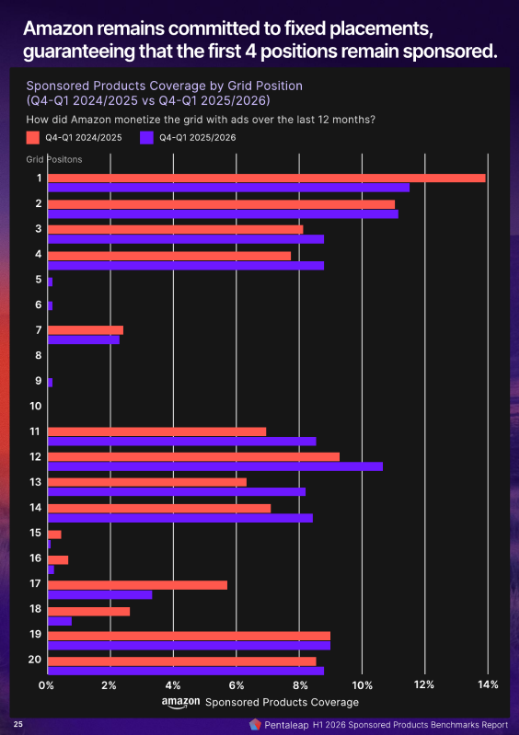
So what: If you're benchmarking your own coverage against Amazon, don't assume “fixed” caps you at four monetizable positions. A fixed anchor can still carry a real fluid tail further down the page, and that tail is exactly the kind of headroom worth counting before you conclude you've hit a ceiling.
Walmart: Relocating Inventory, Not Adding It
Walmart's move this year is the sharpest directional shift of any retailer in the H1 2026 report. Coverage in position 4 nearly disappeared, while positions 6, 7, and 8 went from unused to double digits. Walmart didn't simply add inventory, it relocated a meaningful share of it, away from a top-heavy fixed block and into a wider, more fluid spread further down the page.

So what: The lesson here isn't “add a slot.” It's that revenue growth can come from moving inventory to where it actually performs, not just adding more of it. That's a lever most fixed-only programs haven't touched yet, and it doesn't require new inventory to pull.
Lowe's: Fixed, and Precise About It
Lowe's moved the opposite direction, and the shift is precise enough to name: coverage consolidated into exactly three positions (3, 6, and 9), each running far more often than a year ago, while every other position in the top ten dropped to near zero. That's a fixed model in the most literal sense: every third slot, reliably, and nothing in between.
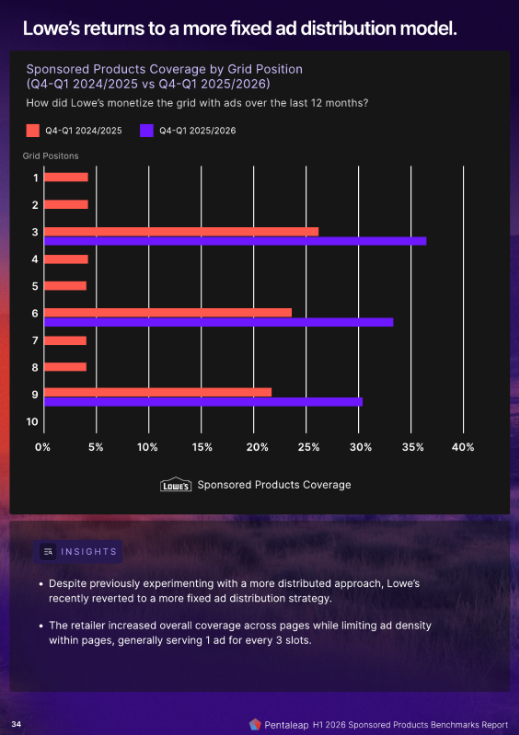
So what: if your own coverage has gone flat, check whether it's actually concentrated into a handful of positions before concluding you're out of room. Lowe's shows a fixed model can still grow, just not by opening new numbered slots.
Is Your Fixed Model Quietly Locking Out Smaller Advertisers?
Here's where it gets more interesting (and where we'd want campaign-level data before calling it settled). Over the same H1 2026 report period, in a separate chapter tracking advertiser concentration, Lowe's head-advertiser share of impressions rose 20 percentage points to 74%, reversing gains smaller advertisers had made the year before. These are two different charts in the same report rather than a single measurement, so treat the connection as a pattern worth watching, not a proven cause and effect.

One plausible mechanism connects the two: a small number of guaranteed, high-traffic fixed slots tend to go to whichever advertiser pays the most for certainty, which typically favors larger, established advertisers who can afford to bid for a reserved position. Fluid placement, by contrast, can surface a smaller or more relevant advertiser without requiring them to win that bidding war.
So what: A placement strategy that quietly concentrates revenue into fewer, larger advertisers is a retention risk, not just a footnote. Lose one or two of those advertisers and you feel it immediately. Worth checking your own head, torso, and tail split before a placement change locks that dependency in further.
How Are Amazon and Walmart Pulling This Off Without Cannibalizing Their Own Search Results?
We don't know what's running under the hood at Amazon or Walmart. But the pattern in the data points to something specific: you can't sustain that much sponsored coverage, spread across that many grid positions, unless the products showing up there stay relevant enough that shoppers keep clicking. Positions 11 through 14 don't stay populated at Amazon, and positions 6 through 8 don't fill in at Walmart, if the ads landing there are dragging the page down.
That's only possible when whatever decides sponsored placement is working from the same relevance signals as whatever decides organic placement, instead of the two running blind to each other.
That coordination is exactly what unified ranking is built to do on purpose, rather than leaving it to chance. Here's how it actually works.
Why the Page You See Was Actually Built by Two Systems
In most onsite retail media stacks, two systems make decisions about the same ecommerce search results page without coordinating. A search and personalization engine ranks the organic products using relevance, inventory, and shopper behavior. A separate ad server decides which sponsored products to show, usually based on bid value, and drops them into a set of reserved tiles. Each system optimizes something different, and neither has visibility into what the other is doing. The result shows up directly in the data: sponsored products that don't get clicks because they weren't relevant to begin with, duplicate listings where the same product appears in both an organic slot and a sponsored tile, and a widening gap between how much inventory exists and how much of it is actually being used well.
What Does Unified Ranking Actually Change About How a Page Gets Built?
Unified ranking means one system decides placement for the whole page, organic and sponsored together, instead of two systems making separate decisions that get stitched together afterward. It doesn't require building a new ranking engine from scratch. It means layering a decisioning step on top of the retailer's existing search and personalization engine, so sponsored products are placed using the same relevance signals that already govern organic results, with the winning bid factored in rather than dictating the outcome.
Pentaleap founder and CEO Andreas Reiffen put it directly in the benchmark report: “the vendor landscape is converging around the same underlying idea: sponsored and organic products can no longer be optimized in separate systems... the decisions retailers make about where that ranking logic lives in their stack will shape their economics, flexibility, and control for a long time to come.”
Does Unified Ranking Require Replacing an Existing Ad Server or Search Engine?
No, and this is the part that tends to get lost. Unified ranking is usually implemented as a layer that sits between a retailer's existing ad server and existing search engine, coordinating the two rather than replacing either. A retailer can keep the ad server it already has a contract with and the search engine it already tuned, and add a coordination layer on top. That also makes it testable: the layer can run alongside the current setup, on a slice of traffic, before anyone commits to a wider rollout. If the numbers don't hold up, nothing about the existing stack has to change.
How Does Unified Ranking Change Where Sponsored Demand Can Come From?
Once ranking is unified, a second question opens up: where does the sponsored demand actually come from? A lot of retail media programs are limited to demand their own direct sales team can close, deals negotiated with one advertiser at a time. Once placement runs through a coordinated layer, it becomes possible to bring in demand from other sources, larger ad networks and programmatic channels, without those sources bypassing the retailer's own ranking logic. This is a separate decision from unified ranking itself; a retailer can adopt one without the other. But the two tend to get discussed together, because opening up demand sources without a coordinated ranking layer just recreates the original problem: multiple systems making independent decisions on the same page.
Control or Independence: What Do You Actually Trade Away With Each Approach?
The trade-off underneath all of this is control versus independence. A single vendor handling both organic ranking and ad serving is simpler to manage: one contract, one roadmap, one team to call. But it also means both decisions live inside one vendor's system, and changing either one later means touching both. A decoupled setup, where a coordination layer sits between separate ad-serving and search systems, means a retailer keeps the ability to swap either piece independently later, without touching the other. Retailers making this move report that the added coordination is worth the independence it buys them, particularly after watching vendor roadmaps and pricing shift underneath long-term contracts elsewhere in their stack.
How Do You Know If Your Retail Media Program Is Ready for Fluid Placement?
Fluid placement isn't the right next step for every retailer, and it isn't a single on or off switch. These three questions are a reasonable way to find out where you actually stand.
1. Have your fixed slots hit a ceiling? If coverage growth has slowed and the only lever left is opening a new numbered position one at a time, that's a sign the fixed model has reached its limit, not a reason to open another slot. Amazon and Walmart both grew coverage this year by changing how existing positions behave, not just by adding new ones. If your growth story only has one move left in it, that's worth naming before you plan next year's roadmap around it.
2. How concentrated is your advertiser base? If a small number of large advertisers account for most of your sponsored impressions, fixed slots may be reinforcing that concentration rather than causing it: guaranteed positions are easiest for the biggest bidders to win consistently. Checking your head, torso, and tail advertiser split before deciding is worth the hour it takes; Lowe's data above is a real example of what that concentration can look like in practice.
3. Do your ad server and your search engine already share a decisioning layer? This is the practical filter. If sponsored and organic ranking already run through a shared decisioning layer (like Pentaleap's), moving toward fluid placement is closer to a configuration change. If they don't, it's an architecture change, worth knowing before it shows up as a surprise line item in an RFP response.
What This Means for Your Business Case
The short version
If the honest answer to “have we hit a ceiling” is yes, the fix usually isn't a bigger ad-serving contract. It's resolving how many systems are deciding what a shopper sees. A few things worth carrying into that conversation:
- Unified ranking is additive. It sits alongside the ad server and search engine you already run, not instead of them.
- It's testable before it's a commitment: a coordination layer can run on a slice of traffic before anyone signs off on a wider rollout.
- The retailers gaining the most ground in the H1 2026 report treated this as an architecture question, not a placement question.
Forward-This Card: For Your CTO
Paste this into a Slack DM or email as-is:
“We don't need to rip anything out to test this. Unified ranking runs as a coordination layer between our existing ad server and search engine, not a replacement for either. It's testable on a slice of traffic before we commit to a wider rollout, and if it doesn't perform, we roll back with nothing changed in the underlying stack. Amazon and Walmart are both already running versions of this; the H1 2026 report shows exactly how.”
The Data Behind This
Every chart and retailer figure in this article, including the five above, is reproduced from Pentaleap's H1 2026 Sponsored Products Benchmarks Report.
Download the complete report: pentaleap.com/reports/h1-2026-sponsored-products-benchmarks-report
Stay Ahead with Retail Radar
Subscribe for cutting-edge insight into the latest retail media developments and trends
.png)

.webp)