Is a Sponsored Click Worth the Organic Sale It Replaced?


A shopper searches "insulated water bottle." A sponsored bottle wins the top slot on a strong bid, gets the click, and earns the retailer its cost-per-click fee. Three rows down sits the bottle the shopper would have bought anyway, at a higher margin.
Ad revenue is the wrong scoreboard for onsite retail media. Every sponsored placement carries a cost the ad report never shows: the margin on the organic product it pushed down.
This piece does the arithmetic finance will ask about. For the approval process itself, see getting ecommerce, search and finance to agree on a ranking change.
TL;DR
- A sponsored placement costs the retailer the margin of whatever product would have held that position otherwise. Ad revenue reports never subtract it.
- That cost varies by placement. Sometimes it is close to zero and the ad is close to pure gain. Sometimes it is larger than the ad fee.
- The fair comparison is total margin per position: ad margin plus product margin for the sponsored product, against product margin for the organic product it would replace.
- A sponsored product should take a position only if that combined number beats the organic product above it. Pentaleap states this rule publicly.
- Ranking on combined margin means a higher bid can lose to a lower one. Pentaleap's own A/B tests also show 2x CTR and 80% to 140% more ad revenue against legacy ad serving.
- Finance should ask to see displaced margin, combined page margin, and a holdout that measures organic sales, not just ad revenue growth.
What does a sponsored placement actually cost a retailer?
A sponsored placement costs the retailer the margin it would have earned from the product that would otherwise have held that position. We'll call that displaced margin.
Positions on a search results page are finite, and the top ones get most of the attention. Every position given to a sponsored product is a position not given to an organic one. The ad report counts the fee that came in. It does not count what the displaced product would have earned, because that product didn't sell, and an unsold product leaves no record.
The size of that cost depends on what got displaced. If the organic product in that position was a weak match the shopper was unlikely to buy, displaced margin is close to zero and the ad fee is close to pure gain. If it was the product the shopper came for, displaced margin can be larger than the ad fee itself.
So the argument here is not that sponsored products are bad for retailers. It's that their cost changes from one placement to the next, and most retailers can't see it at the placement level at all.
There is public evidence that the gap between sponsored and organic performance can be wide. A large fashion retailer and Pentaleap customer found its sponsored products generated less than half the click-through rate of adjacent organic products and converted at less than 40% of their rate. When a sponsored product converts at less than half the rate of the product next to it, the margin it displaces is not a rounding error.
Why doesn't ad revenue show that cost?
Ad revenue doesn't show displaced margin because the two numbers live in different systems, owned by different teams, reported in different meetings.
In a legacy setup, the ad server chooses which sponsored product fills a fixed tile, and the search engine ranks the organic products around it. Neither system sees the other's economics. Pentaleap's own comparison of the two models lists the legacy ad server's goal as maximizing ad revenue, and the goal of a unified ranking layer as maximizing margin across both ecommerce and advertising. A system built to maximize ad revenue has no reason to report a number that would make its own results look smaller.
The reporting follows the same split. Retail media owns the ad revenue line. Ecommerce and merchandising own conversion and product margin. Finance sees both, but as separate lines in a monthly pack, never side by side for the same position on the same page.
The industry name for the worst version of this is cannibalization: paying to show ads for products shoppers would have clicked on organically anyway. The ad gets credit for a sale the retailer would have made regardless, and the product margin on any sale that didn't happen disappears from view.
We've written separately about the conversion side of this problem, including how to spot what sponsored revenue costs in organic conversion through pogo-sticking and CTR gaps. This piece puts that cost in currency, because currency is what finance signs off on.
How do you compare ad margin and product margin on the same page?
You compare them by adding them up per position and asking which product, sponsored or organic, produces the larger total.
Pentaleap's public version of the rule is simple: if a sponsored product generates more total margin than the organic product above it, it should take that spot, and if it generates less, it shouldn't. Whether the margin comes from a media fee or a product sale is secondary. What matters to the business is the sum.
Here is how that plays out. The numbers below are illustrative, invented to show the mechanics, not drawn from any retailer's data.
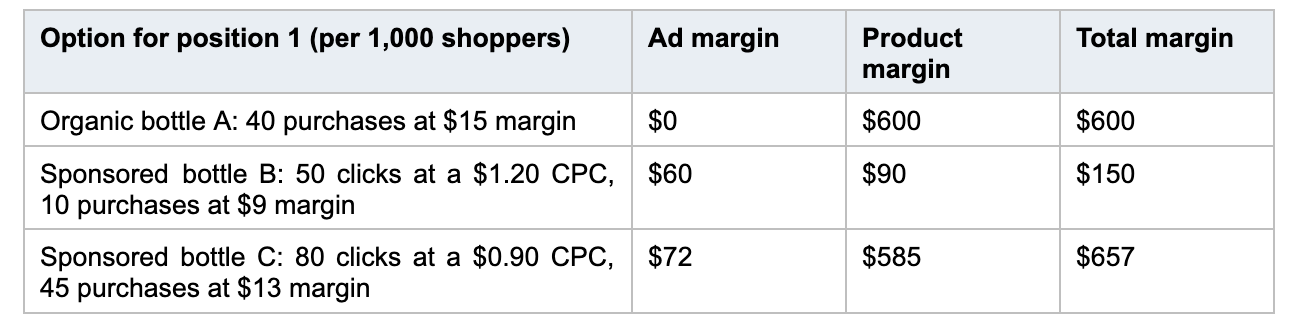
An ad-revenue scoreboard picks bottle C, but only narrowly over bottle B, and it would happily accept B, since $60 of ad revenue beats the $0 that organic bottle A earns. A combined-margin scoreboard rejects B, because it costs the retailer $450 of margin to collect $60 of ad revenue. It accepts C, because C beats the organic product even though C bid less than B.
The example simplifies one thing on purpose. Bottle A doesn't vanish when it loses position 1; it still sells some units from lower down the page, and a real ranking system counts that too. The principle doesn't change, only the size of the numbers.
Pentaleap calls the combined figure compound margin: retail margin plus ad margin, computed together, so that a highly relevant sponsored product can outrank an organic one, and an organic product with strong retail margin can outrank a mediocre ad (why retail media and merchandising keep fighting each other).
What changes when the ranking maximizes margin instead of ad revenue?
Three things change, and one of them is a real trade-off.
First, bid stops being the deciding factor. A sponsored product with a higher bid can lose a position to one with a lower bid if the cheaper product is the one shoppers are more likely to buy. Bottle C beating bottle B in the example above is the same pattern described in how injected ad slots decide which sponsored product wins.
Second, the sponsored products that win tend to be the ones shoppers actually click. Pentaleap reports that unified ranking A/B tests show 2x CTR and 80% to 140% more ad revenue compared with legacy ad serving. Pentaleap attributes that lift to improved relevance producing more paid clicks.
Third, and this is the trade-off, some placements that used to earn ad revenue stop being served. Bottle B in the example would have produced $60 of ad revenue that the retailer no longer collects. If your retail media team carries an ad revenue target, that loss is real to them, even when the business is better off. Finance can help here by agreeing in advance that the retail media team is measured on combined margin, or at least that it isn't penalized for placements the ranking correctly declined.
That third point is where most of the internal friction sits, and it's why the scoreboard question has to be settled before the ranking change goes live, not after the first monthly report.
What should finance ask to see in the reporting?
Finance should ask for numbers that show the cost side of every sponsored placement, not just the revenue side. Five requests cover most of it:
- Displaced margin by category. For sponsored placements in a category, which organic products would have held those positions, and what margin would they have been expected to earn? Placement-level detail is ideal; category-level is a workable start.
- Combined page margin as the headline number. Ad margin plus product margin, reported together for the pages where sponsored products run, ahead of ad revenue rather than as a footnote to it.
- A holdout that measures organic sales. A test on a slice of traffic that reports organic conversion and product margin on the same pages, in the same window, alongside sponsored performance. We've covered how to design that kind of holdout in detail.
- The objective, in writing. Which single number does the ranking system maximize? If the answer is ad revenue, every other report from that system should be read with that in mind.
- The margin input, and who owns it. A ranking that uses product margin needs product margin data. Ask which margin figure goes in, how often it updates, and who on your side is accountable for it being right. That person is often in finance.
None of these requires a new analytics project before a vendor conversation. They're questions to put to any vendor you're evaluating, including us. The answers tell you whether a system can see the cost of its own placements, or only the revenue.
Three Diagnostic Questions
#1 Does your current reporting show the margin of the organic product each sponsored placement displaced?
#2 Is your ad system's goal ad revenue, or margin across ecommerce and advertising?
#3 If ad revenue rose 20% last quarter, can you say how much of it came from displacing your own higher-margin sales?
Key Takeaways
- Ad revenue measures what a sponsored placement earned, not what it cost. The cost is the margin of the organic product it displaced.
- Displaced margin varies by placement, from close to zero to more than the ad fee, and most retailers can't see it at the placement level.
- The fair comparison is total margin per position: ad margin plus product margin for the sponsored product, against product margin for the organic product it would replace.
- Ranking on combined margin means a higher bid can lose to a lower one. It also means some ad revenue the old model collected will no longer be collected.
- Pentaleap reports 2x CTR and 80% to 140% more ad revenue in unified ranking A/B tests against legacy ad serving.
- Finance should ask for displaced margin, combined page margin, a holdout on organic sales, the ranking objective in writing, and clear ownership of the margin input.
Frequently Asked Questions
What is the true cost of a sponsored product placement for a retailer?
The true cost is the margin the retailer would have earned from the organic product that would otherwise have held that position. Ad revenue reports record the fee a sponsored placement earns, but not the product margin it displaces. Depending on what was displaced, that cost can be close to zero or larger than the ad fee.
What is cannibalization in retail media?
Cannibalization is when sponsored products take positions, and get credit for sales, that organic products would have earned anyway. The retailer collects an ad fee on a sale it would have made regardless, or loses a higher-margin organic sale to a lower-margin sponsored one.
How do you compare ad revenue and product margin on the same page?
Add them up per position. For a sponsored product, total margin is the ad margin from its clicks plus the product margin from its sales. Compare that with the product margin of the organic product it would replace. The product with the larger total should take the position.
Can retail media revenue grow while a retailer's total margin falls?
Yes. If sponsored products displace higher-margin organic products that shoppers would have bought, ad revenue can rise while combined margin across ads and product sales falls. That is why ad revenue on its own is an incomplete scoreboard.
Does ranking on margin reduce retail media ad revenue?
It removes placements where a sponsored product earns less in total than the organic product it would replace, so some ad revenue the old model collected goes away. Pentaleap reports that unified ranking A/B tests show 2x CTR and 80% to 140% more ad revenue compared with legacy ad serving.
What should a CFO ask a retail media vendor before approving a ranking change?
Ask which single number the ranking maximizes, whether reporting shows the margin of displaced organic products, whether a holdout test will measure organic sales on the same pages, and which product margin data the ranking uses.
Stay Ahead with Retail Radar
Subscribe for cutting-edge insight into the latest retail media developments and trends